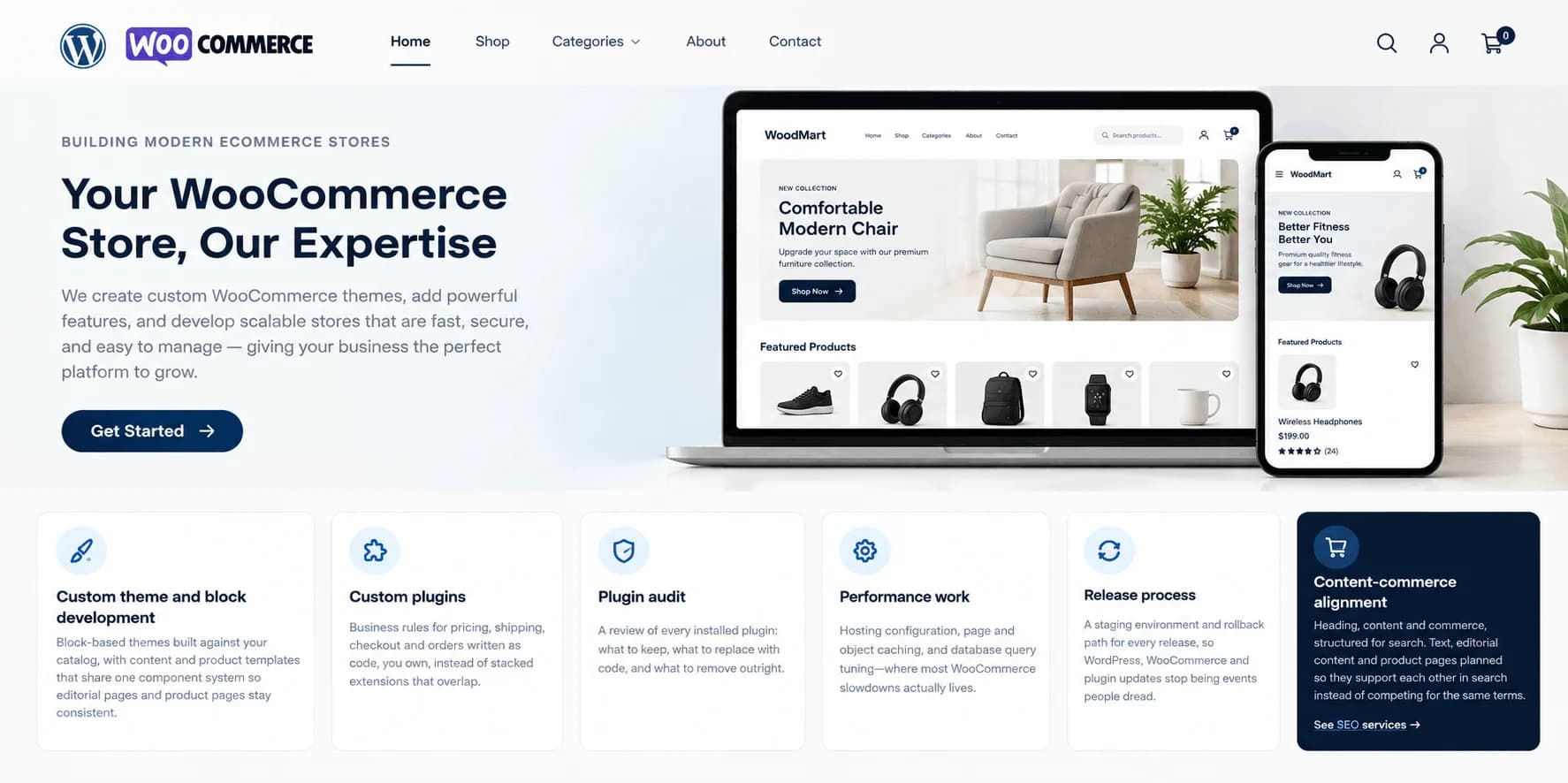
WooCommerce development for stores that need content and commerce together.
1Dot Digital builds and maintains WooCommerce stores that need more than a theme and a stack of plugins: block-based themes, custom plugins for your business rules, plugin audits, and hosting, caching and database work that keeps the store fast as the catalog grows.
For brands where editorial content drives the catalog, or where pricing, shipping or checkout logic no extension handles cleanly, WooCommerce gives you code-level control and full ownership of your data and hosting.
- Content and commerce together
- WordPress
- Code-level business rules
- Custom plugins
- Hosting, caching, queries
- Performance
- Custom plugins
- Plugin audit
- Performance work
- Release process
Capabilities
What we build on WooCommerce
Custom theme and block development
Block-based themes built against your catalog, with content and product templates that share one component system so editorial pages and product pages stay consistent.
Custom plugins
Business rules for pricing, shipping, checkout and orders written as code you own, instead of stacked extensions that overlap.
Plugin audit
A review of every installed plugin: what to keep, what to replace with code, and what to remove outright.
Performance work
Hosting configuration, page and object caching, and database query tuning — where most WooCommerce slowness actually lives.
Release process
A staging environment and rollback path for every release, so WordPress, WooCommerce and plugin updates stop being events people dread.
Content-commerce alignment
Heading: Content and commerce, structured for search. Text: Editorial content and product pages planned so they support each other in search instead of competing for the same terms.
Store types
Who we build WooCommerce stores for
Content-led
Publishers and brands where editorial content drives catalog sales.
Custom rules
Pricing, shipping or checkout logic that no extension expresses cleanly.
Membership
Gated content, subscriptions and account-based access.
Data ownership
Stores that need full control of their data, hosting and code.
Process
How a WooCommerce engagement runs
Discovery
Plugin inventory, hosting, catalog, integrations and the business rules that need custom code.
Design
Block-based templates for content and product pages, built as one component system.
Build
Theme, custom plugins and integrations, developed in staging.
Test & launch
Performance, accessibility, SEO and checkout testing, then a cutover runbook with a rollback path.
Growth
Scheduled updates, performance monitoring, CRO tests and SEO on a retained plan.
Considering headless?
Headless WooCommerce is an option, not the default.
A Next.js front end over the WooCommerce Store API can deliver layouts a theme can't, but it adds a second system to host and maintain. Most WooCommerce stores are better served by fixing plugins, hosting and caching first. Our headless page shows when it pays off and what it costs to run.
Is headless right for you?FAQ
WooCommerce questions
Our store has 40 plugins. Where do you start?
With a plugin audit. We map every plugin to the features and data that still depend on it, then decide what to keep, what to replace with custom code and what to remove. Most stores end up with fewer plugins doing more predictable work.
Is WooCommerce fast enough?
Yes, with disciplined engineering. Most WooCommerce slowness comes from hosting configuration, caching and database query design rather than the platform itself. We profile the slow templates first, then fix hosting, caching and queries before changing anything visible.
Can you take over an existing build?
Yes, after a code and plugin review. We'll say plainly if a rebuild is cheaper than maintaining what exists. You get a written summary of what we would keep, fix first and replace.
How do you handle WooCommerce and plugin updates?
On a schedule, tested in staging, with a rollback path — not whenever something breaks.
Should we use WooCommerce or Shopify?
WooCommerce suits stores where content, custom business rules or data ownership matter most. Shopify suits teams that want less to maintain. We build on both and will recommend the one that fits your catalog, rules and team. See Shopify development.
Can you build custom WooCommerce plugins?
Yes. Pricing, shipping, checkout and order rules are written as code you own and can hand to any developer, in place of stacked extensions.
Planning a WooCommerce build, rebuild or cleanup?
Tell us about your plugins, hosting and business rules. We'll confirm WooCommerce is the right fit before we scope the work.