GetTent BigCommerce Development
OVERVIEW
BigCommerce for a specialist event-equipment catalog
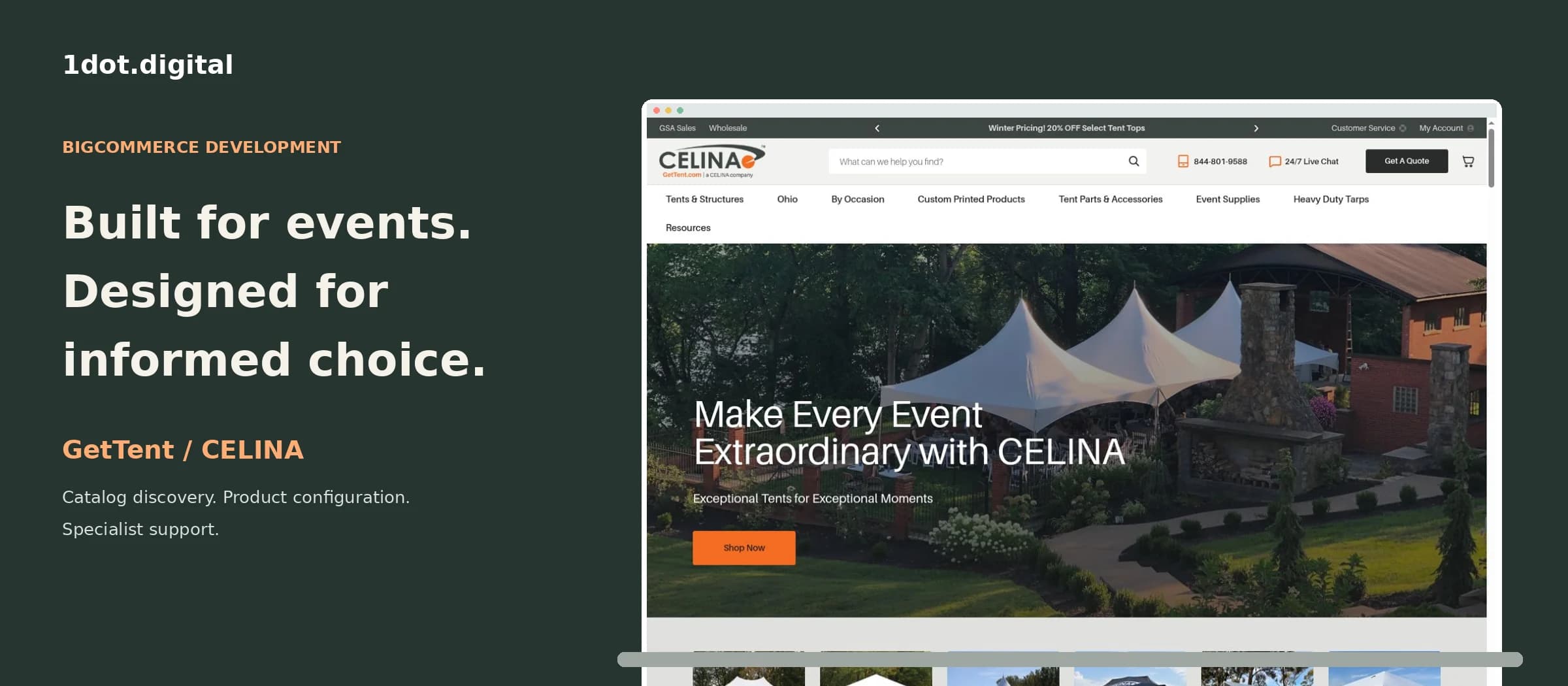
GetTent, a CELINA company, brings commercial tents, structures, accessories and event equipment into one shopping destination. This case study focuses on the BigCommerce development storefront supplied for review and the way its interface connects product discovery, configuration and specialist assistance. The brief identifies BigCommerce development as the project scope. The supplied store is publicly accessible but labels itself GetTent.com Sandbox. Its homepage, pole-tent collection and a configurable product page were inspected on 6 October 2026. Screenshots in this presentation come from that environment; gettent.com was used only for brand context. The central design objective is a clear route from an event requirement to a suitable tent system. Buyers need to understand tent type, dimensions, components and support options before committing to a high-consideration purchase.
CHALLENGE
Make technical purchasing approachable
A tent catalog contains more than visual styles. Buyers may need a complete kit, a replacement top, sidewalls, anchoring equipment or a custom printed solution. Discovery must explain these relationships without overwhelming the customer. The interface must serve customers who know a tent type and customers who begin with an occasion. The reviewed navigation provides both routes, alongside parts, event supplies and custom printed products. Configurable products introduce another challenge: option labels, specifications and component compatibility must remain consistent. The inspected product shows fabric-top, eave-height and pole-kit selections, making precision in product data essential.
APPROACH
Connect inspiration with practical product decisions
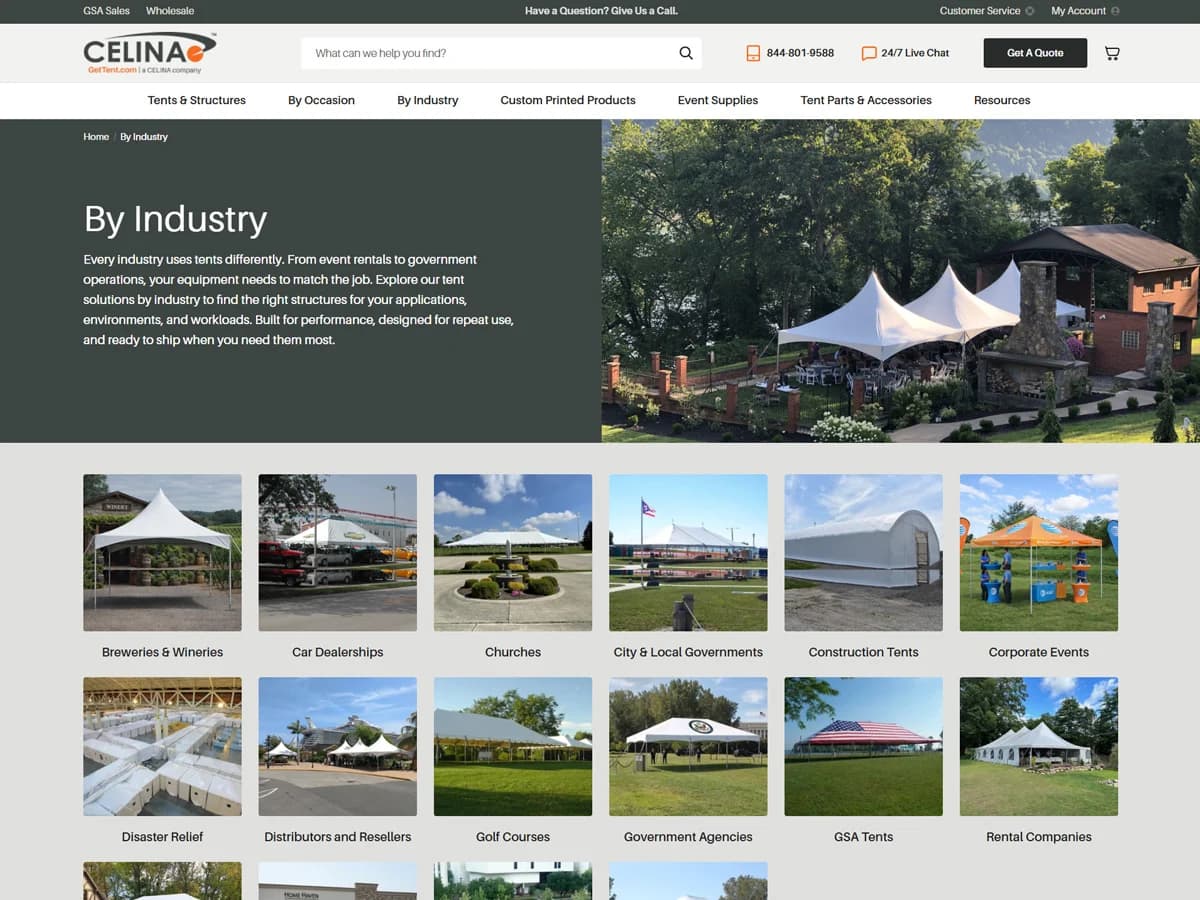
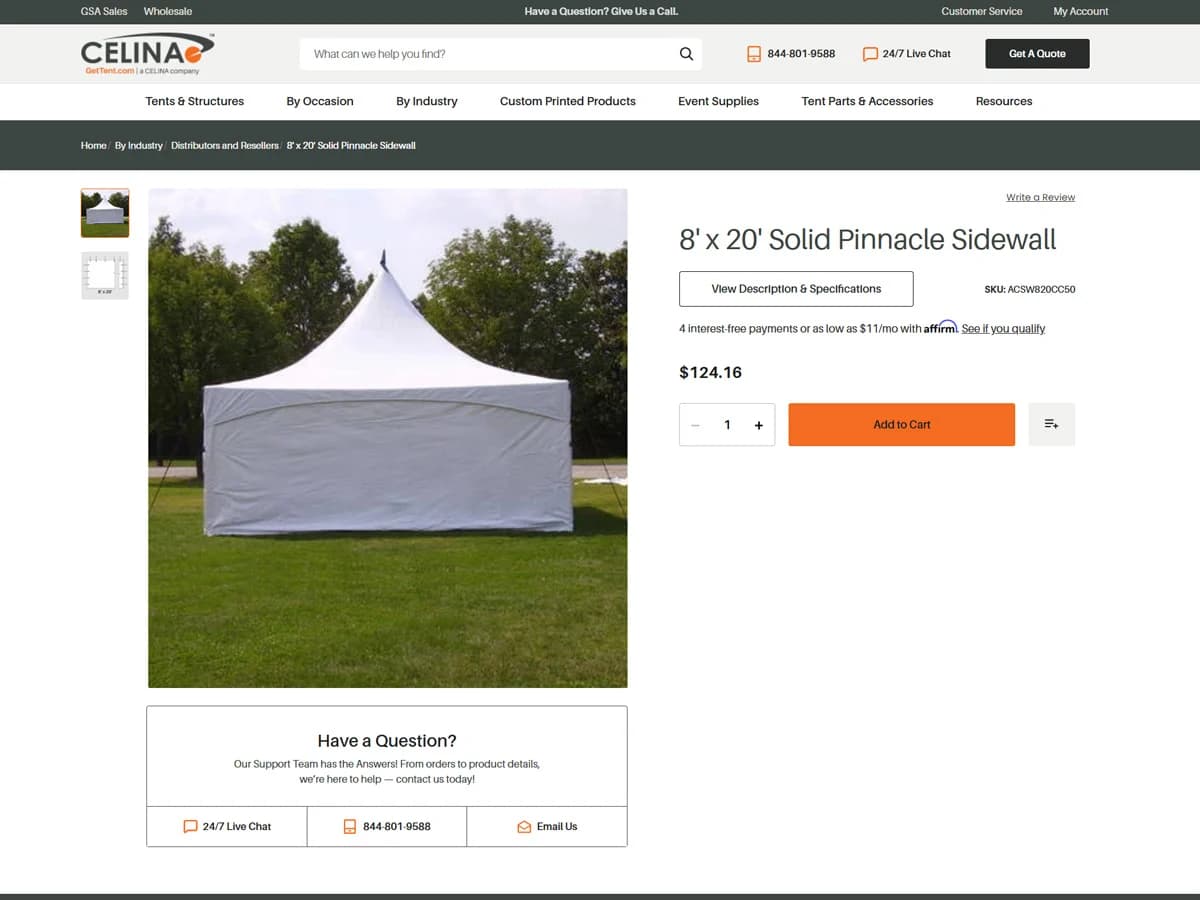
The homepage starts with event photography and a shopping action, then introduces tent-type shortcuts and occasion-based discovery. This sequence offers an aspirational entry point before presenting the catalog. The collection page narrows the journey with a category heading, photography, breadcrumbs, filter controls, sorting and comparison access. A support panel remains nearby for buyers who need help choosing equipment. The product page combines a large image, thumbnail gallery, SKU, description access and configuration fields. The header retains phone, live-chat and quote links, giving buyers a visible route to assistance throughout the journey. These observations describe the reviewed interface, not a verified record of agency delivery.
DESIGN
A confident industrial identity with event-led imagery
The storefront pairs CELINA branding with charcoal-green surfaces, white backgrounds and bright orange actions. Large photographs show tents in use, helping customers imagine the equipment within a real event setting. A broad search field anchors the header. Phone, chat and quote actions sit beside it, while category navigation occupies a separate row. The result supports both self-directed browsing and assisted purchasing. Collection pages use a split introduction: title and action on one side, a tent photograph on the other. Below, the filter rail and product grid establish a familiar catalog structure. Product pages use a gallery beside the title, summary and configuration controls. The case-study presentation follows the supplied agency-style reference through navy headings, restrained blue labels, white cards, a section index and framed original screenshots. GetTent orange and charcoal-green appear in the image compositions to connect the presentation to the storefront.
DEVELOPMENT
BigCommerce storefront foundations
The supplied mybigcommerce.com store establishes the development platform. Visible commerce elements include category navigation, search, product cards, pricing, pagination, sorting, filter controls, comparison access, wishlist access and cart controls. The inspected product uses required configuration fields for the fabric top and eave height with tube material/type; a stake-size field also appears. These fields make product setup part of the buying interface. Option dependencies, price recalculation and inventory behavior were not tested. Quote, wholesale and GSA entry points provide paths for more specialised purchasing. Their presence does not establish account-specific pricing, approval workflows or a B2B backend implementation. Theme source, custom code ownership, migration history, APIs, ERP connections, payment configuration and order fulfilment were not available for inspection. No integration or custom architecture is claimed without project evidence.
BUYER JOURNEY
From event requirement to product configuration
Discover: enter through the homepage, a tent-type shortcut or an occasion category. Narrow: review the relevant collection, use sorting and available filters, and inspect product cards. Evaluate: open the product and review imagery, SKU, description and configuration labels. Configure: assess the fabric top, pole kit and anchoring requirements. Seek assistance: use the visible quote, phone or chat route if sizing or compatibility is unclear. Purchase: cart controls are present, but adding an item, checkout and payment were outside this review. The strongest improvement opportunity is contextual guidance beside technical options. Clear explanations of what is included, what changes with each selection and which accessories are required would reduce ambiguity. This is a recommendation, not a completed feature claim.
ON-PAGE SEO
Useful structure for commercial tent intent
The reviewed pages expose category and product headings, breadcrumb navigation and descriptive product text. These are visible foundations for page comprehension. The case-study copy targets GetTent BigCommerce development naturally through its title, opening paragraph and development section. Before launch, align each product title, browser title, URL, SKU and option set. The inspected browser title refers to a 20-foot by 40-foot tent while the visible heading and URL use 18-foot by 40-foot wording. Verify the intended specification rather than assuming either is correct. Replace placeholder articles and test product names with approved content. Review canonical URLs, redirects, sitemap inclusion, robots directives and structured data against the production domain. Keep the development store out of public search if it is intended solely for staging; this review did not verify its indexing configuration. Create useful category introductions and link related tents, replacement components and support resources. Write image alternatives for the actual product view. Validate performance and accessibility before claiming improvements; no ranking or speed gains are asserted here.
RESULTS
An observable storefront, with measurement still to establish
The reviewed development storefront demonstrates a joined-up presentation of event imagery, tent categories, catalog controls and configurable product information. Its support routes remain prominent across the inspected pages. The evidence supports a design and interface case study. It does not establish launch completion, revenue uplift, conversion improvements or operational savings. Test products, placeholder articles and data inconsistencies make a launch-readiness review appropriate. To publish measured results, add approved launch dates and scope, then compare agreed pre-launch and post-launch periods. Useful measures include product discovery, search usage, configuration completion, cart progression, quote enquiries and conversion. Define each measure consistently and account for seasonality.
LAUNCH CHECKLIST
Resolve the remaining content and data gaps
Priority 1: remove test products and placeholder blog posts; replace missing-image placeholders; confirm the correct product dimensions and align titles, URLs and options. The category screenshot preserves these development artifacts rather than disguising them. Priority 2: review the mixed links between the supplied store host, its sandbox alias and gettent.com. Confirm the intended destination of each navigation and merchandising action. Review the Ohio navigation item and filter brands Common Good and OFS against the approved catalog taxonomy. Priority 3: proofread category benefits. The reviewed pole-tent text claims no interior obstructions despite also describing center poles; correct the guidance to match the actual product structure. Validate the final catalog, responsive layout, keyboard operation, forms, cart, checkout and order notifications before release.
CLOSING
GetTent demonstrates a BigCommerce development direction for a technical event-equipment catalog: show the equipment in context, organise discovery around familiar needs and bring configuration and support into the same journey. The next step is to resolve the staging content, confirm the delivery record and validate the production buying flow. With those checks and approved analytics, this case study can evolve from an observed development presentation into a measured project success story.
Ready to build a better store?
Tell us about your business, current platform and goals. We'll recommend the right path and send a scoped quote.